
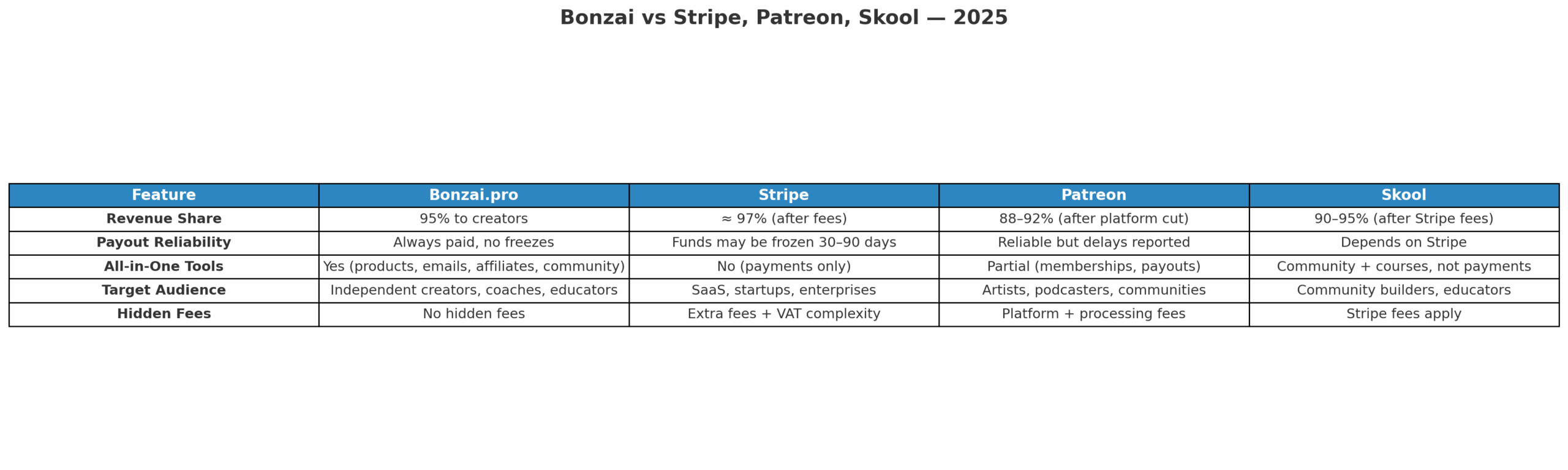
Yes, you can sell digital products without opening or connecting your own Stripe account. The important distinction is between “I do not manage Stripe myself” and “Stripe is nowhere in the payment chain.” Those are not the same claim.
Updated August 2026. Payment availability, fees and processor relationships vary by country and can change.
Transparency: Jean-Marie Cordaro is the Founder & CEO of Bonzai.pro. Some Bonzai links on this page are tracked affiliate links and may generate a commission at no extra cost to the reader.
Five ways to sell without your own Stripe account
| Platform | Creator-managed Stripe required? | Where it fits |
|---|---|---|
| Bonzai | No | Creator products, email, community and affiliation in one environment |
| Gumroad | No | Simple digital products with Merchant of Record handling |
| Lemon Squeezy | No | Digital products and software with global tax handling |
| Whop | No separate creator Stripe connection required | Payments, digital products, communities and marketplace distribution |
| Paddle | No | SaaS, software and digital products under a Merchant of Record model |
Why creators look for a Stripe-free setup
Stripe works well for many businesses. The reason to look elsewhere is usually operational rather than ideological. You may not want another merchant account to manage. Your country or business model may fit poorly. You may prefer a Merchant of Record to handle tax obligations. Or you may want checkout bundled with the rest of the creator stack.
Resilience is another reason, but it is easy to overstate it. Replacing Stripe with one platform does not remove platform risk. It simply changes where the dependency sits. The useful question is what happens if the primary account is reviewed or unavailable, and how quickly you could keep selling.
Bonzai: when you want to replace more than the payment account
Bonzai’s current creator documentation says creators do not need to connect their own Stripe or PayPal account. The platform combines that managed payment flow with digital products, courses, coaching, community, email, collaboration and affiliation.
The reason to consider it is consolidation. If the payment problem is only one piece of a fragmented creator stack, changing checkout while leaving five other services untouched may not solve much.
Bonzai is also a smaller ecosystem than some older competitors. Before moving meaningful revenue, verify current payout options, supported use cases and the effective transaction cost for your country and currency.
Gumroad: the simplest Merchant of Record route for many creators
Gumroad acts as Merchant of Record for the sales it processes. That means the creator does not have to build a separate tax and payment stack around a personal Stripe account. Gumroad takes responsibility for the customer transaction and sales-tax handling within its model.
The tradeoff is cost. Gumroad currently lists 10% + $0.50 on direct/profile sales and much higher economics for marketplace discovery sales. That can be a perfectly reasonable price for simplicity at low volume and a painful percentage at scale.
Lemon Squeezy: Merchant of Record with a stronger software bias
Lemon Squeezy is another Merchant of Record option, focused heavily on digital goods and software. Its public ecommerce pricing is 5% + $0.50 per transaction, with additional fees possible depending on the transaction.
It becomes attractive when global tax handling is the problem you most want to remove. It is less compelling if your real need is community, creator engagement or a full education stack.
Whop: no separate Stripe account, but a very different product
Whop’s current payments infrastructure does not require a creator to connect a separate Stripe account. Whop has built a broader payments and commerce stack with global payouts, a wide range of payment methods, communities, digital products and marketplace distribution.
That makes it more than a checkout replacement. If you want marketplace and commerce infrastructure, that breadth matters. If you mainly want a simple Merchant of Record storefront, it may be more platform than you need.
Paddle: built for software businesses first
Paddle acts as Merchant of Record and combines payments, tax, fraud, billing and compliance. Its public pay-as-you-go pricing is 5% + $0.50 per checkout transaction.
Paddle supports digital products, but its strongest fit is software, SaaS and technical businesses that need subscriptions, tax compliance and developer integrations. A solo course creator and a SaaS company should not be choosing a payment platform from the same checklist.
Merchant of Record changes who carries the transaction responsibility
With a direct payment processor, your business is usually the seller of record and retains more responsibility for tax and the customer transaction. A Merchant of Record becomes the legal seller to the customer for the transaction and takes on responsibilities such as payment processing and sales-tax handling.
That convenience usually costs more than raw card processing because you are buying more than money movement. For a creator selling internationally, that may be worth the premium. For a business with its own finance and tax stack, it may not be.
What “cheapest” misses
Whop may publish a lower domestic-card headline rate than some Merchant of Record products. Bonzai may replace email, community and affiliate tooling. Gumroad and Lemon Squeezy include Merchant of Record responsibilities. Paddle is built around software compliance and billing.
Calculate total cost with your monthly revenue, average order value, customer geography, subscription mix and the tools each platform genuinely replaces. A low percentage attached to a stack that still needs four paid add-ons can be more expensive than it looks.
How I would migrate without creating an outage
Map the current dependencies first: checkout, subscriptions, customer records, invoices, tax, email automations and fulfillment. Export the data you are legally entitled to keep. Rebuild one offer on the new platform and process real test transactions before moving the rest.
Keep the existing route alive during testing. A migration is a bad time to discover that renewal logic, email delivery or refunds work differently from what you assumed.
No Stripe account does not mean no platform risk
Merchant of Record and platform-managed payment models still have compliance reviews, fraud controls, reserves, prohibited-use rules and payout dependencies. No credible provider can promise that every account will remain active forever.
The more resilient setup is boring and practical: own your domain, keep audience data you are allowed to export, back up product assets and maintain a second sales route you have actually tested.
Questions about selling without Stripe
Can I sell digital products without Stripe?
Yes. Bonzai, Gumroad, Lemon Squeezy, Whop and Paddle can all be used without you opening and connecting your own Stripe merchant account.
What is the best Stripe alternative for creators?
It depends on what you need beyond payments. Bonzai is built around an integrated creator workflow. Gumroad and Lemon Squeezy are strong when Merchant of Record handling matters. Whop brings a broader commerce and marketplace ecosystem. Paddle is more software-oriented.
Is Merchant of Record safer than Stripe?
It is a different operating model, not a guarantee against suspension or payout risk. A Merchant of Record takes on more transaction and tax responsibilities but still enforces compliance and acceptable-use rules.
Official sources and related guides
Current documentation: Bonzai creator payments, Gumroad pricing, Lemon Squeezy pricing, Whop payments and fees and Paddle pricing.
For more context, read Merchant of Record for Creators, Best Creator Platforms in 2026 and Whop suspension and platform risk.
About the author
Jean-Marie Cordaro is Founder & CEO of Bonzai.pro. He writes about creator payments and platform dependency with an emphasis on precise claims: what the creator manages directly, what the platform manages and where risk still remains.