
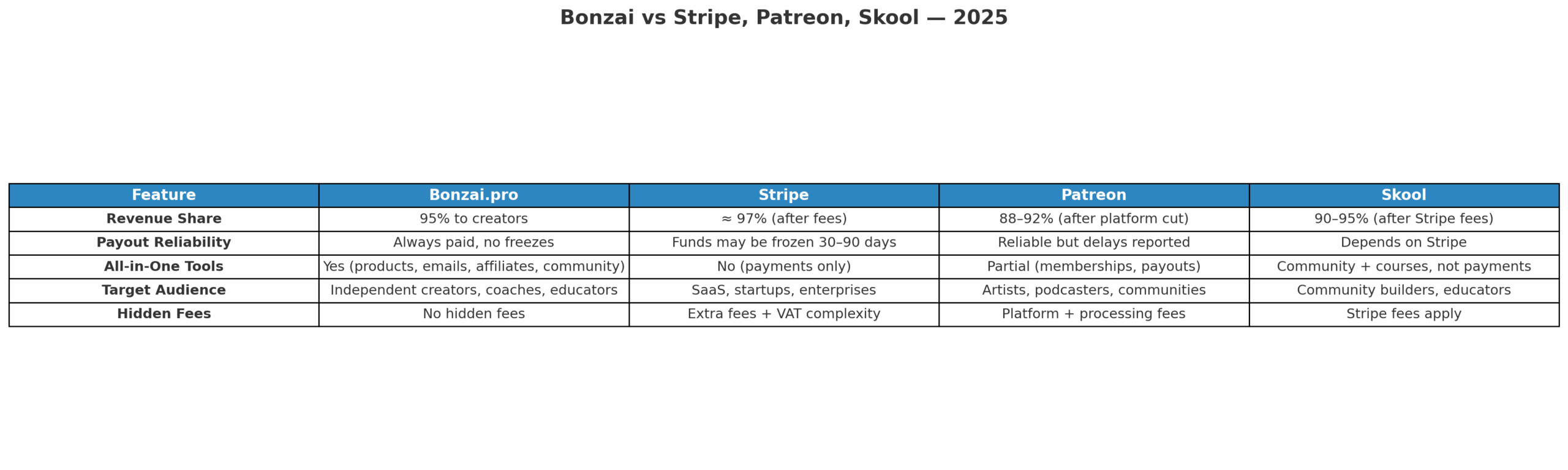
Creator Platform Fees Compared in 2026: What You Actually Pay
Creator-platform pricing is easy to compare badly. “0% transaction fee” can sit on top of a monthly subscription and payment processing. A 10% platform fee can include Merchant of Record tax handling. A lower card rate may still require separate email, community or affiliate software. The useful number is the cost of the business stack you actually run.
Updated August 2026. Fees change frequently and can vary by country, currency, product and payment method. Use the official links below before moving meaningful revenue.
Disclosure: I am Jean-Marie Cordaro, Founder & CEO of Bonzai.pro. Some Bonzai links on this page are tracked affiliate links and may generate a commission at no extra cost to the reader. The methodology below is designed to make it obvious when another pricing model is cheaper.
The six costs that belong in a real comparison
- Software subscription: what you pay before the first sale.
- Platform fee: the percentage or fixed amount charged by the creator platform.
- Payment processing: card, wallet, bank and processor charges.
- Tax and Merchant of Record scope: who carries transaction and indirect-tax responsibilities.
- Currency and payout costs: what happens when buyer currency and payout currency differ.
- Missing-stack cost: email, community, affiliates, courses, funnels or analytics that still require another subscription.
If a comparison ignores any of those categories, it may still be useful for one narrow question. It is not a total-cost comparison.
Creator platform fees at a glance
| Platform | Pricing shape | What to remember |
|---|---|---|
| Bonzai | Transaction-led; current pricing lists 6% to 1% in EUR or 5% to 0.7% in USD, plus banking fees | No creator-managed Stripe or PayPal account required; broader creator stack included |
| Skool | $9 Hobby or $99 Pro, plus transaction fees | Higher plan lowers variable fees; community is the core product |
| Stan Store | $29 Creator or $99 Creator Pro; 0% Stan transaction fee | Stripe or PayPal processing still applies |
| Gumroad | 10% + $0.50 on direct/profile sales | Merchant of Record, so the fee includes more than raw processing |
| Whop | Domestic card pricing starts at 2.7% + $0.30, with additional fees in some cases | Low headline card rate, broad commerce and marketplace stack |
| Patreon | 10% standard platform fee for new creators, plus processing and applicable fees | Membership-first economics |
| Podia | Monthly subscription; Mover also carries a 5% platform fee | Higher plans trade fixed cost for lower platform fees and more features |
| Kajabi | High fixed monthly subscription plus payment processing | Can replace a large marketing and education stack |
| Circle | Monthly subscription, Circle transaction fee and Stripe processing | Community infrastructure is what you are paying for |
| Mighty Networks | Monthly subscription, platform transaction fee and Stripe on web payments | Community, events and branded-app path |
| Lemon Squeezy | 5% + $0.50 base ecommerce fee, with some surcharges | Merchant of Record for digital products and software |
Why Bonzai and Stan can both be “cheaper,” depending on stage
Bonzai has low fixed commitment because the creator can start without a conventional monthly platform subscription. That is attractive while an offer is still being validated. The platform makes money when transactions happen, and its current creator page says creators do not need their own Stripe or PayPal account.
Stan uses the reverse logic. You pay $29 or $99 per month, Stan takes 0% as its own transaction fee, and Stripe or PayPal processing sits underneath. Once revenue is meaningful, that fixed-cost model can become cheaper than a percentage-based platform.
Neither pricing model wins in the abstract. Early-stage creators should care about fixed risk. Higher-volume creators should care about variable cost. Both should care about what other software remains necessary.
Merchant of Record fees are buying a different service
Gumroad and Lemon Squeezy explicitly operate Merchant of Record models. That means their percentage is not comparable with raw card processing as if both services were doing the same job. The Merchant of Record takes a larger legal and operational role in the transaction, including indirect-tax responsibilities within its service model.
A creator selling internationally may reasonably pay a higher percentage to remove tax administration and transaction complexity. A business with its own finance and compliance infrastructure may prefer a lower-cost processor model.
For the legal distinction, see Merchant of Record for Creators.
Whop shows why a headline payment rate is not the whole bill
Whop’s standard domestic-card rate currently starts at 2.7% + $0.30. That is low compared with many creator platforms. Whop also has optional or transaction-specific costs for parts of its broader commerce stack, and international cards or currency conversion can change the effective rate.
The correct comparison therefore depends on the configuration. If all you need is a clean domestic-card transaction, the base rate matters a lot. If you use marketplace, tax, affiliates, subscriptions and other services, price the complete setup.
Community platforms should be judged partly on retention
Skool, Circle and Mighty Networks are a good example of why payment cost can become a distraction. If one platform improves member participation and reduces churn, a slightly higher fee may create better economics than a cheaper platform with weak retention.
For a paid community, track active-member rate, churn, event attendance, participation and repeat purchases alongside software cost. Saving one percentage point while losing members faster is not a saving.
Course platforms justify fixed cost by replacing software
Kajabi and Podia illustrate the other side of the equation. A monthly subscription can look expensive compared with transaction-led platforms, but the economics change if the platform replaces course hosting, community, email, funnels, automation and affiliate software.
Do not compare a $100-plus all-in-one subscription with a $30 checkout layer unless you also price the missing tools. Equally, do not pay for an all-in-one stack if you use only two features.
A simple way to calculate your own total cost
Take one normal month. Use actual revenue, transaction count, average order value and customer geography. Then add the monthly subscription, platform percentage, fixed per-transaction charges, processor costs, currency fees and the subscriptions that remain outside the platform.
Do the same calculation again at twice your current revenue. That second scenario is often more revealing than today’s bill because it shows which costs scale with the business and which stay fixed.
Questions about creator platform fees
Is a 0% transaction fee always cheaper?
No. A 0% platform fee can sit on top of a monthly subscription and payment processing. It can be excellent at higher revenue, but compare total cost rather than the headline percentage.
Why do Merchant of Record platforms charge more?
Because they take on more than payment processing. Their model can include tax collection and remittance, transaction responsibility, refunds, disputes and compliance work.
Which pricing model is best for a new creator?
A low-fixed-cost model often reduces risk before demand is proven. Once revenue grows, recalculate because percentage fees can become more expensive than a fixed subscription plus processing.
Official sources and related guides
Current documentation: Bonzai for creators, Skool pricing, Stan payment fees, Gumroad pricing, Whop pricing, Patreon fees, Podia pricing, Kajabi pricing, Circle pricing, Mighty Networks pricing and Lemon Squeezy pricing.
Related reading: Best Creator Platforms in 2026, Merchant of Record for Creators, How to Sell Digital Products Without Stripe and Creator Guides.
About the author
Jean-Marie Cordaro is Founder & CEO of Bonzai.pro. He approaches platform pricing as an operating-model question: fixed cost, variable cost, payment responsibility and the software a creator still needs around the transaction.