
Best Platforms for Paid Communities in 2026: 8 Options Compared
A paid community platform should be chosen around the reason members keep paying. If the value is member-to-member participation, use a community-first product. If the community supports courses, coaching or a wider creator business, a broader platform may be more economical even if its community features are less specialized.
Updated August 2026. Pricing and platform capabilities change. Current claims below are based on the official sources linked on this page.
Disclosure: I am Jean-Marie Cordaro, Founder & CEO of Bonzai.pro. Some Bonzai links are tracked affiliate links and may generate a commission at no extra cost to the reader. Specialist community platforms are stronger than Bonzai in several use cases described below.
First decide what the member is buying
A mastermind sells access to peers and judgment. A cohort course sells progress with accountability. A fan membership sells proximity and ongoing creator output. A coaching program may use community only to keep clients engaged between calls.
Those are different products. The software should follow the retention mechanism rather than the other way around.
| Community model | Platforms I would compare first |
|---|---|
| Community is the product | Skool, Circle, Mighty Networks |
| Course plus community | Skool, Kajabi, Podia, Bonzai |
| Coaching plus community | Bonzai, Circle, Kajabi, Podia |
| Professional network or association | Circle, Mighty Networks |
| Fan membership | Patreon |
| Paid group mixed with software or access products | Whop |
Skool, Circle and Mighty Networks: community is the main event
Skool is the simplest of the three. Discussion, classroom content and live calls sit inside one member experience, with pricing that starts low on Hobby and moves to a higher Pro subscription with lower transaction fees. Its strength is focus. If members return because they like participating, Skool is difficult to dismiss.
Circle gives brands more control over community structure, branding, profiles, events and workflows. It is a better fit for professional communities, networks and programs where the member environment needs to feel more customized. The cost is higher, and Stripe processing sits alongside Circle’s own plan and transaction economics.
Mighty Networks belongs in the same specialist group, with courses, events, memberships, automations and a path toward branded apps for larger businesses. It makes more sense when the community itself is becoming a product company, not just a chat room around another offer.
Bonzai, Kajabi and Podia: community as part of a wider business
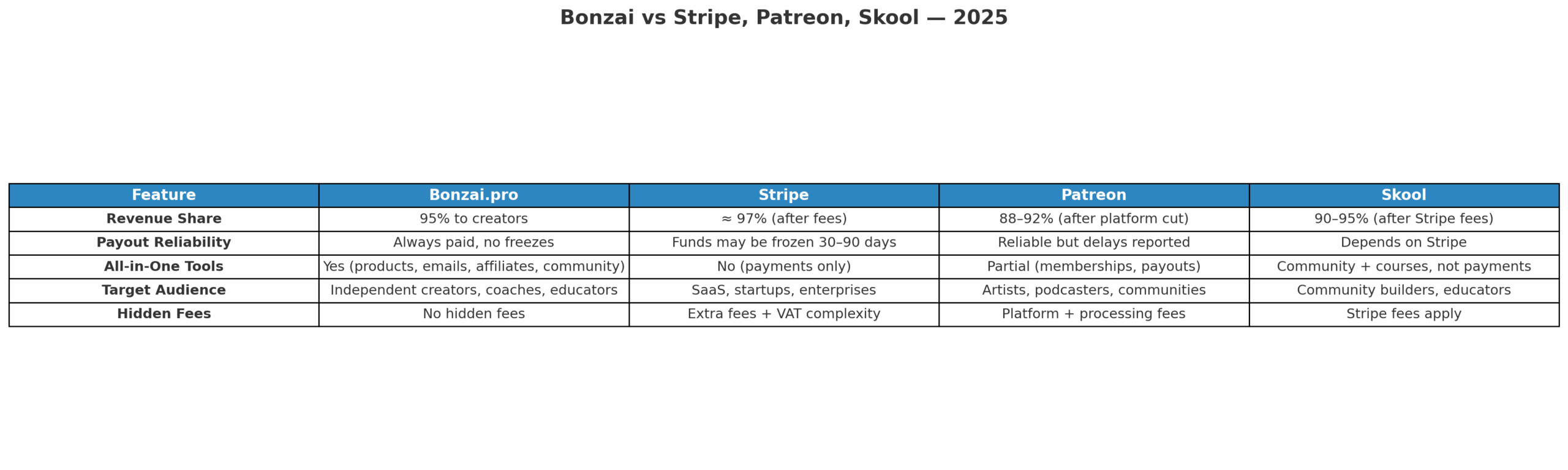
Bonzai combines paid groups with courses, coaching, digital products, subscriber capture, email and affiliation. Its current pricing states that no creator-managed Stripe or PayPal account is required. Platform fees are volume-based, from 6% to 1% in EUR and from 5% to 0.7% in USD, plus banking fees.
I would use Bonzai when community is one revenue stream among several. I would not use it merely to imitate Skool, Circle or Mighty. Those platforms have deeper specialist community design. Bonzai’s advantage appears when consolidating the surrounding creator stack matters more than maximizing community-specific features.
Kajabi is the heavier knowledge-business option. Community can sit beside courses, coaching, websites, email, funnels and automation. That breadth is expensive if the paid group is your only offer and rational if the community is one layer in a mature education company.
Podia is simpler. It combines community with courses, coaching, downloads and email at a lower fixed cost than Kajabi. For creators who want one conventional customer account for education and membership without deep community customization, that can be enough.
Whop: community as an access product inside a commerce ecosystem
Whop is useful when a paid group is bundled with courses, software, coaching or other gated products. Chat, forums, livestreams and apps can sit inside the same commercial environment, while Whop’s marketplace and payments layer can also contribute to acquisition and checkout.
This breadth creates a different kind of dependency. If a large share of customer access, payments and distribution all live in the same platform, portability deserves attention. That is why my Whop suspension article focuses on concentration rather than claiming one platform is uniquely risky.
Patreon: membership without turning the community into software
Patreon works when the audience already understands the proposition: pay regularly to support the creator and receive ongoing access or benefits. It now offers community chats and membership tools, but it remains easier to understand as a creator-membership platform than as a professional community operating system.
That simplicity can outperform a sophisticated community product when the audience is buying the creator relationship rather than networking, coursework or structured peer interaction.
Retention can matter more than a cheaper transaction fee
A paid community with lower fees and weak participation can be more expensive than a platform that keeps members active for longer. The unit economics should include member churn, not just checkout cost.
Track recurring revenue, churn, active-member rate, event attendance, discussion participation and repeat purchases. If courses are part of the offer, track completion. If coaching is part of the offer, track renewal or upgrade behavior. Those numbers tell you whether the community is delivering enough value to remain paid.
Do not underestimate the software outside the community
A specialist community platform may still need email, CRM, funnels, course hosting or affiliate software. A broader creator platform may save those subscriptions while giving up some community depth. Put every required tool into the monthly cost model before deciding that one platform is cheaper.
The Creator Platform Fees Compared in 2026 guide covers the cost structure in more detail.
Questions about paid community platforms
What is the best paid community platform in 2026?
Skool, Circle and Mighty Networks are strong when community itself is the product. Bonzai, Kajabi and Podia make more sense when community sits inside a wider creator or education business. Whop is strong for access products and Patreon for recurring fan membership.
Which platform is best for courses and community?
Skool is strong when learning depends on participation. Kajabi and Podia are more education-stack oriented. Bonzai is relevant when courses and community sit beside coaching, products, email and affiliation.
Which paid community platform is best for coaches?
It depends on whether the community is the product or a retention layer around coaching. Circle is strong for structured professional communities. Bonzai, Kajabi and Podia are more natural when coaching, products and community need to live closer together.
Official sources and related guides
Current documentation: Skool pricing, Circle pricing, Mighty Networks pricing, Bonzai for creators, Kajabi pricing, Podia pricing, Whop pricing and Patreon fees.
Related reading: Bonzai vs Skool in 2026, Best Skool Alternatives in 2026, Best Platforms to Sell Online Courses in 2026 and Creator Platform Fees Compared in 2026.
About the author
Jean-Marie Cordaro is Founder & CEO of Bonzai.pro. He evaluates paid communities through retention, member behavior and the wider creator stack rather than treating community software as a list of features.