
Best Skool Alternatives in 2026: 8 Platforms for Communities and Courses
Skool is difficult to replace if the community itself is the product. Its simplicity is part of the appeal: discussion, classroom, calls and paid access all live in one member experience. The alternatives become more interesting when your problem is somewhere else, such as email, branding, payment structure, course marketing, marketplace discovery or running several types of offers from the same business.
Updated August 2026. Prices and payment details can change. Current claims on this page are tied to the official platform sources listed below.
Disclosure: I am Jean-Marie Cordaro, Founder & CEO of Bonzai.pro. Some Bonzai links on this page are tracked affiliate links and may generate a commission at no extra cost to the reader. Several platforms below are a better fit than Bonzai for community-first businesses.
The shortlist, organized by the problem you are solving
| If your priority is… | Start with |
|---|---|
| A broader creator business around community | Bonzai |
| A polished branded community | Circle |
| Community-led memberships, events and branded-app ambitions | Mighty Networks |
| A mature course and marketing business | Kajabi |
| Straightforward courses, coaching and email | Podia |
| Payments, access products and marketplace distribution | Whop |
| Recurring fan membership | Patreon |
| Social-first storefront selling | Stan Store |
Before leaving Skool, be specific about what is missing
Skool currently offers a low-cost Hobby plan and a higher-priced Pro plan, both built around unlimited members, courses, videos and live calls. Its payment model is also tightly integrated with the platform rather than asking creators to connect an existing Stripe account.
That is a strong proposition if the paid group is the business. It becomes less complete when you need a serious acquisition-email system, a highly branded member environment, several unrelated product formats, advanced funnels or a commerce layer that reaches beyond the community itself.
Bonzai: when the community sits inside a wider creator business
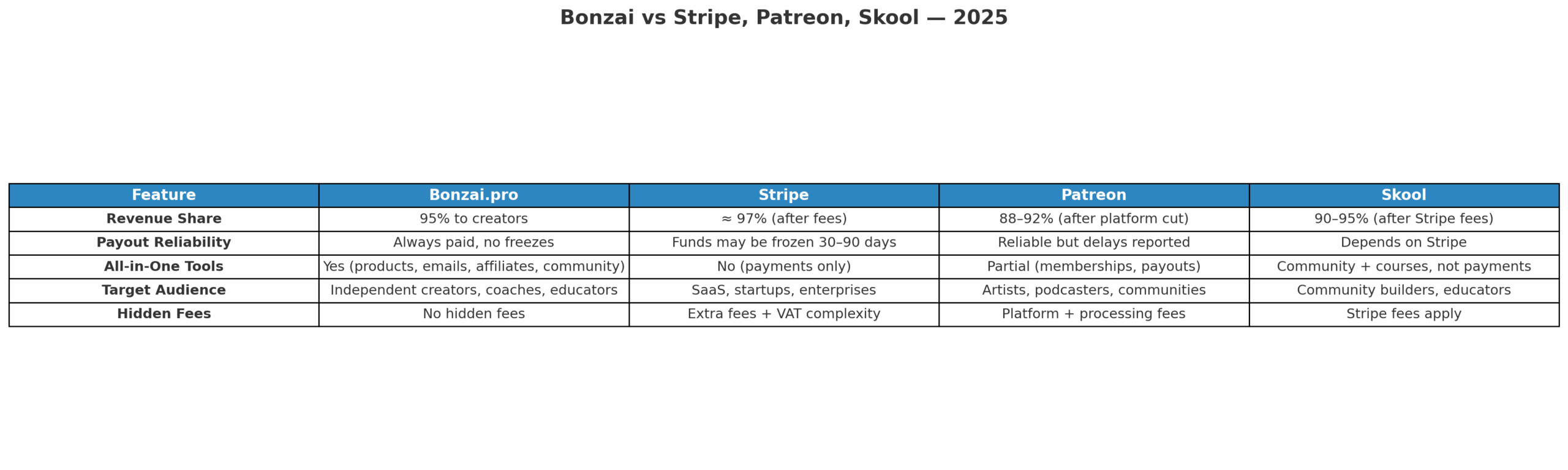
Bonzai supports courses, coaching, paid groups and other digital products, with subscriber capture, creator email and affiliation around the same hub. Its current creator page says creators do not need their own Stripe or PayPal account because Bonzai handles the creator-facing payment flow.
I would compare Bonzai when Skool feels too narrow for the business around the group. If you are selling a course, adding coaching, running a community and asking affiliates to distribute the offer, keeping those workflows closer together can reduce operational friction.
I would not choose Bonzai over Skool because it has more adjacent tools. Skool has the clearer dedicated community experience. Bonzai becomes relevant when the extra scope is actually used.
Circle and Mighty Networks: when community design matters more than simplicity
Circle is one of the more natural alternatives for professional networks, cohort communities and branded membership programs. It offers deeper control over community structure, branding, member profiles, events and workflows than Skool, at a higher fixed cost. Payments use a connected Stripe setup and Circle adds its own transaction fee by plan.
Mighty Networks is similar in spirit but particularly relevant for community-led memberships, events and businesses that may eventually want a branded-app path. It also starts at a materially higher monthly price than Skool Hobby and uses Stripe for web payments.
Both products make sense when the community itself deserves more design freedom and infrastructure. Neither is the obvious move if your only complaint is that Skool’s transaction fee looks high.
Kajabi and Podia: when the real business is education
Kajabi belongs in a different cost class. It combines courses, coaching, communities, websites, email, funnels and automation. For an established knowledge business, that can replace enough software to justify the subscription. For a small paid group, it can be a very expensive way to solve a problem Skool already handles cleanly.
Podia is the more approachable middle ground. Courses, coaching, downloads, community and email live together, with a simpler interface and lower fixed cost than Kajabi. It is useful when the course catalog and customer communication matter more than community gamification.
Whop: when marketplace and commerce matter more than the classroom
Whop has expanded into a broad payments and commerce platform. It supports digital access, communities, courses, software and marketplace distribution, with its own current payments infrastructure rather than a creator-managed Stripe setup.
If you expect the platform to become an acquisition channel, or you need a broader commerce layer around access products, Whop deserves serious consideration. The tradeoff is focus: a Skool group is simpler to understand when the product is simply a paid community with courses and calls.
Patreon and Stan Store solve two completely different problems
Patreon is useful when membership means recurring support, proximity to the creator and ongoing access rather than structured community learning. Its consumer proposition is familiar and the setup is relatively light.
Stan Store is useful for almost the opposite reason. It is a social-first storefront with courses, booking, lead capture and more advanced marketing tools on its Pro plan. If the customer journey starts on Instagram or TikTok and community depth is secondary, Stan can be a better operational fit than Skool.
What changes the decision fastest
Three variables usually matter more than a long feature checklist. First, what keeps members paying: community participation, course progress, access to you or a bundle of services? Second, where does acquisition happen: email, social, marketplace, affiliates or referrals? Third, which part of the stack becomes expensive as revenue grows?
If the answer to the first question is “the community itself,” Skool may already be the right product. If the answer is “the community is one layer around a broader creator business,” the alternatives become much more compelling.
Questions about Skool alternatives
What is the best Skool alternative for community?
Circle and Mighty Networks are the closest specialist alternatives when you want deeper branding, community structure and workflows. They also start at a higher fixed cost than Skool Hobby.
What is the best Skool alternative for courses?
Kajabi and Podia are strong when courses, email and marketing are the center of the business. Bonzai is relevant when courses sit alongside coaching, community, products and affiliation.
Can I run a paid community without my own Stripe account?
Yes. Bonzai says creators do not need their own Stripe or PayPal account. Skool uses its own payment setup and creates a Stripe Express connection for creator payouts. Whop also provides platform-managed payments.
Official sources and related guides
Current documentation: Skool pricing, Skool Payments FAQ, Bonzai for creators, Circle pricing, Mighty Networks pricing, Kajabi pricing, Podia pricing, Whop pricing, Patreon fees and Stan Store plans.
Related reading: Bonzai vs Skool in 2026, Best Platforms for Paid Communities in 2026, Best Platforms to Sell Online Courses in 2026 and Creator Platform Fees Compared in 2026.
About the author
Jean-Marie Cordaro is Founder & CEO of Bonzai.pro. He compares creator platforms by the business model they are designed to run, not by the length of the feature list.